
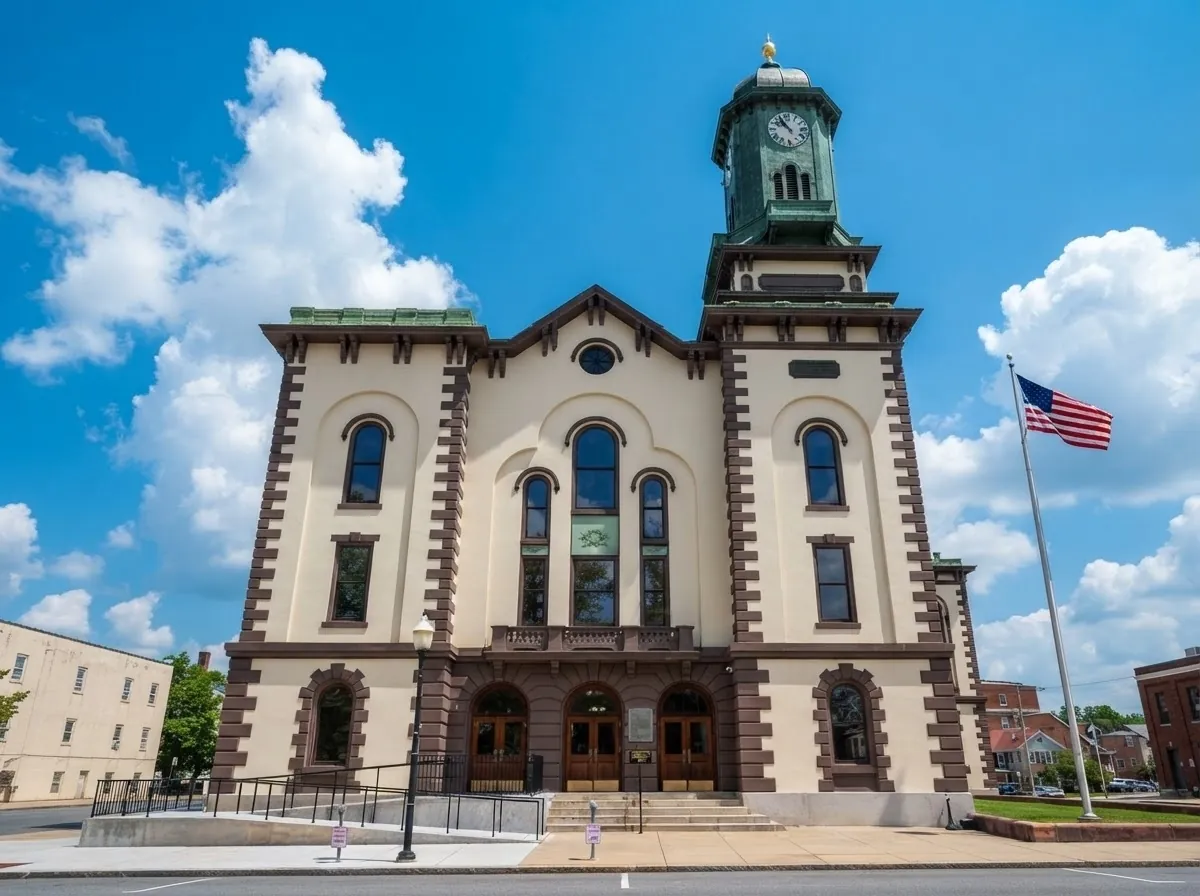
Court records in Northumberland County, Pennsylvania, are maintained by the Clerk of Courts and the Register & Recorder's office. NorthumberlandCourt.us allows quick access to public information about court records in this county. Additionally, records can be searched through the Pennsylvania Unified Judicial System portal, directly at the Clerk of Courts, or through other state government resources.
Northumberland Court System Overview
Northumberland County is part of the 8th judicial district of Pennsylvania, which exclusively serves this county. The Court of Common Pleas handles criminal, civil, family, and probate cases. The court's page on the Unified Judicial System website is available on the official portal. The lower tier consists of Magisterial District Courts, which operate in several locations within the county. The court administrator coordinates the work of both levels.
Courts Serving Northumberland
| Court | Address / Contacts |
|---|---|
| Northumberland County Court of Common Pleas | 201 Market Street, Sunbury, PA 17801 |
| Magisterial District Courts (several districts within the county) | Addresses and phone numbers of individual districts are listed on the county page on the PA Courts portal |
| U.S. Middle District of Pennsylvania (federal district court) | 235 N. Washington Ave., Scranton, PA 18503 |
| U.S. Bankruptcy Court, Middle District of Pennsylvania | 197 S. Main Street, Wilkes-Barre, PA 18701 |
What Types of Cases Northumberland Courts Hear
The county courts hear a wide range of cases. Here are the main categories:
- Criminal cases — felonies, misdemeanors, violations
- Civil lawsuits, including small claims disputes
- Family law — divorce, custody, support, protective orders
- Probate matters — wills, estate management, guardianship
- Juvenile cases — juvenile proceedings and child protection
- Traffic violations and DUI
- Adoption and termination of parental rights
District Court Cases in Northumberland
The Court of Common Pleas is the general jurisdiction court where serious cases are heard. Felonies are transferred here after a preliminary hearing in the magistrate court. Civil lawsuits exceeding the magistrate's jurisdictional limit are also heard here. A judge is assigned to the case according to internal distribution, and parties receive notice of the hearing date through the clerk's office. Appeals from magistrate judges' decisions are brought to the Court of Common Pleas, where the case is heard anew (de novo). Post-conviction motions — such as requests for sentence review — are also filed with this court.
Magistrate Court Cases in Northumberland
Magisterial District Courts serve as the "gateway" to the judicial system for most residents. This is where preliminary hearings in felony cases are held, and misdemeanors and violations are addressed. Civil claims up to $12,000 fall under the magistrate's jurisdiction. Small claims disputes are limited to $12,000 by Pennsylvania law. Traffic fines, DUI arrests, and initial hearings on protective orders all start here. Magistrate judges also issue arrest and search warrants. If a party disagrees with a decision, the case can be appealed to the Court of Common Pleas.
Family Law, Probate, and Juvenile Matters in Northumberland
Family Law
Divorce, child custody, support, protective orders from domestic violence, and paternity establishment are handled by the family law division of the Court of Common Pleas. Termination of parental rights also falls under this court's jurisdiction.
Probate Matters
The Register & Recorder's office accepts wills for probate and maintains the register of probate cases. The appointment of guardians and administrators for incapacitated persons or minors is the court's competence, but documents are filed through the Register & Recorder's office on the first floor of the courthouse.
Juvenile Matters
Juvenile proceedings are confidential. Cases of juvenile delinquency and child protection (Child Protective Act) are handled by a separate division of the Court of Common Pleas. Access to these materials is restricted by law.
How Cases Move Through the Northumberland Court System
- Case Initiation. Criminal — through complaint filing or arrest; civil — through a complaint; family or probate — through a petition.
- Judge Assignment. The clerk's office distributes the case among judges according to the court's internal rules.
- Initial Hearing. In criminal cases, this is an arraignment, where the defendant is read the charges. In civil cases, it's a scheduling conference.
- Pre-trial Phase. Filing motions, exchanging evidence (discovery), plea negotiations, or settlement discussions.
- Trial or Resolution. The case may conclude with a jury verdict, plea, settlement, or default judgment.
- Post-Decision. Sentencing, filing an appeal, or enforcing the court's decision.
Court Administration, Local Rules, and Public Access in Northumberland
The administrative judge of the 8th judicial district oversees the organizational work of the courts. The Trial Court Administrator is responsible for daily management, hearing schedules, and staffing. Contact the administrator through the court's main number.
Local court rules are published on the Northumberland County page on the PA Courts portal. They regulate document filing deadlines, motion formats, and other procedural matters.
Most court records in Pennsylvania are public — except for juvenile cases, sealed materials, and records protected by court order. Public access to court documents is governed by the administrative rules of the PA Unified Judicial System. Requests for public records under the Right-to-Know Law can be submitted through the Office of Open Records portal.
Hearings are generally open to the public. Some proceedings may be held remotely — check with the clerk's office or on the PA Judiciary web portal.
Court Records and Related Court Resources in Northumberland
- Case Search. UJS Portal Case Search allows searching for cases in the Court of Common Pleas and magisterial courts by name or case number.
- Payment of Court Costs and Online Case Viewing. Through the PA Judiciary web portal, you can find public information about cases, warrants, and hearing schedules.
- Criminal History Check. The PATCH (Pennsylvania Access To Criminal History) system allows obtaining a criminal history report online. More details on the procedure are on the criminal history background check request page.
- Property and Deed Registry. The Register & Recorder of the county maintains records of property, wills, and marriage licenses at 201 Market Street, 1st Floor, Sunbury.
- Inmate Search. If a person is in a state correctional facility, use the Inmate Locator of the PA Department of Corrections. More details are on the inmate or parolee search page.
- Birth and Death Certificates. Requested through Vital Records of the PA Department of Health.
- Digitized County Historical Records. The Digitized Records Guide of the PA State Archives contains materials available for researchers.
- Public Records Requests. The Office of Open Records PA coordinates requests under the Right-to-Know Law.
- State Police Reports. Public information release reports PSP are available by Troops serving the county.